
Power Conversion Housings
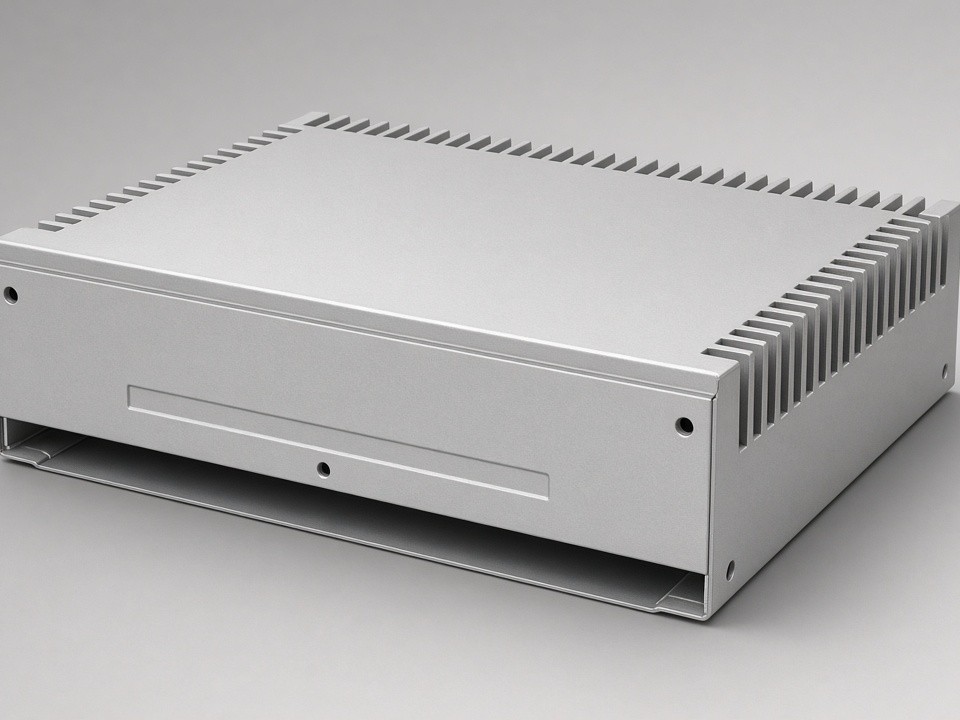
Power conversion equipment requires enclosures that maintain structural integrity while allowing airflow, cable routing, and mounting points. Housings for inverters, rectifiers, and converters often combine flat panels with formed features and welded seams. Sheet metal remains the standard choice because it supports quick design iterations and consistent part-to-part repeatability across batches.
- Cut Edge Tolerance
- ±0.10 mm
- Sample Lead Time
- 3–12 days
- Production Lead Time
- 15–25 days
Material Thickness and Grade Selection
Customers specify materials based on corrosion resistance, thermal conductivity, and weight targets. We stock common grades and thicknesses that match typical power electronics requirements. All incoming coils and sheets receive thickness verification and surface inspection before release to cutting.
Stainless Steel
SUS304 & SUS316 · 1.0–3.0 mm
Suited to outdoor or wash-down environments where corrosion resistance is the priority.
Carbon Steel
SPCC & Q235 · 1.5–6.0 mm
Used for indoor frames that receive powder coating after fabrication.
Aluminum
5052 & 6061 · 1.0–4.0 mm
Selected when weight reduction or heat dissipation matters most.
Cutting, Bending, and Feature Addition
Fiber laser cutters handle both outer contours and internal patterns in a single setup, with standard tolerances at ±0.10 mm on cut edges. Seven CNC press brakes form flanges and return edges up to 3000 mm long with 230-ton capacity. Formed features such as stiffening ribs or cable entry knockouts are added during the same bending cycle when the drawing permits.
Forming and Punching
- CNC punching creates precise hole patterns and louvers without secondary operations.
- Formed features are integrated during the bending cycle to reduce handling steps.
Threading and Hardware
- M2–M12 threads are tapped after forming.
- PEM hardware is pressed in place on the same fixture set.
- Keeping all work on one set of fixtures reduces the chance of tolerance stack-up.
Welding and Assembly Steps
TIG and MIG/MAG welding join seams on frames and multi-panel enclosures. Spot welding secures overlapping flanges where cosmetic appearance allows. Laser welding is available for visible stainless surfaces that must remain flat after joining. Completed assemblies receive hardware insertion, grounding studs, and basic mechanical testing before surface treatment.
-
TIG and MIG/MAG Welding
Joins seams on frames and multi-panel enclosures.
-
Spot Welding
Secures overlapping flanges where cosmetic appearance allows.
-
Laser Welding
Available for visible stainless surfaces that must remain flat after joining.
-
Final Assembly
Hardware insertion, grounding studs, and basic mechanical testing before surface treatment.
Inspection and Documentation Package
Every order follows the documented flow of IQC, FAI, IPQC, FQC, and OQC. CMM and 2.5D vision systems record critical dimensions listed on the customer drawing. First-article reports, material certificates, and RoHS statements ship with the parts. ISO 9001:2015 certification covers the entire process.
Prototype-to-Production Continuity
A single order can start with one-piece prototypes and move directly into repeat batches without requalification of tooling or fixtures. Lead times run 3–12 working days for initial samples and 15–25 days for production quantities once the process is locked. This overlap removes the need to source a second supplier when volumes increase.
IQC
Incoming quality control
FAI
First article inspection
IPQC
In-process quality control
FQC
Final quality control
OQC
Outgoing quality control — with first-article reports, material certificates, and RoHS statements shipped alongside the parts.
Request for Quotation
Send PDF, DXF, or STEP files along with material call-outs, finish requirements, and target quantities. We return a DFM review and priced quote within one business day for most inquiries.
Email Your RFQEmail: [email protected]
What to Include
- Files in PDF, DXF, or STEP format.
- Material call-outs and finish requirements.
- Target quantities and any production schedule constraints.
Address: Sanjiang Industrial Zone, Hengli Town, Dongguan City, Guangdong Province, China