Custom Sheet Metal Fabrication
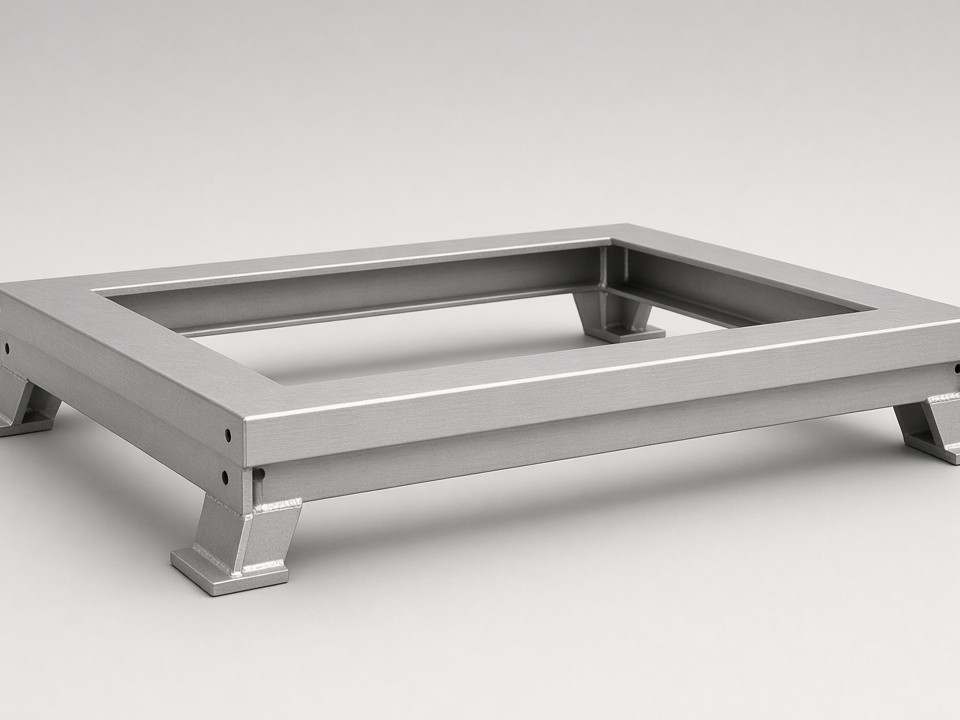
Custom Base Frames for Industrial Equipment
Base frames support motors, pumps, enclosures, and automation modules where alignment and load distribution matter. Most projects start from a STEP or SolidWorks file that shows mounting hole patterns, weld callouts, and surface finish requirements.
Typical Construction Methods
Base frames combine flat patterns cut on fiber lasers, bent on CNC press brakes, and joined by TIG or MIG welds. Additional operations include PEM insertion for threaded standoffs, countersinking for flush hardware, and grinding of weld seams before coating. The sequence stays the same whether the order is one prototype or a repeat batch of 50 units.
Step 01
Laser Cutting
Flat patterns cut on fiber lasers to drawing.
Step 02
Press Brake Forming
Bent on CNC press brakes to the required geometry.
Step 03
Welding & Hardware
TIG or MIG welds, PEM insertion, countersinking, and seam grinding.
Step 04
Inspection
Welded assemblies receive CMM and 2.5D inspection before shipment.
Fabrication Capacity for Base Frames
Rapidsheetfab processes frames up to 4000 mm long and 12 mm thick on five fiber lasers and seven press brakes.
ISO 9001:2015 procedures cover incoming material checks through final outgoing verification.
| Parameter | Capability |
|---|---|
| Max sheet size | 2000 × 4000 mm |
| Laser thickness (steel) | up to 25 mm |
| Laser thickness (aluminum) | up to 16 mm |
| Bend length | up to 3000 mm / 230 T |
| Hole position tolerance | ±0.10–0.20 mm |
| Bend angle tolerance | ±0.20–0.30° |
| Standard materials | SUS304/316, SPCC, Q235, 5052/6061 Al, C1100 copper |
How Lead Times Affect Project Schedules
3–12
Working days
Prototype
Ships once drawings and material are confirmed, letting mechanical teams test mounting positions and cable routing before committing to production tooling.
10–15
Days
Small Repeat Orders
Repeat batches move steadily, reducing the need to carry safety stock.
15–25
Days
Scheduled Production
Planned volumes help avoid delays to equipment builds.
Materials and Finish Options
Common choices include 3–6 mm Q235 or 5052 aluminum for painted frames and SUS304 for corrosion-exposed applications. After fabrication, frames move to qualified partners for powder coating, anodizing, or zinc plating. These steps remain outside our facility and are quoted separately with documented process records.
Painted Frames
3–6 mm Q235 or 5052 aluminum.
Corrosion-Exposed
SUS304 for demanding environments.
Powder Coating
Handled by qualified partners, quoted separately.
Anodizing & Zinc Plating
Documented process records supplied with each order.
Projects That Fit This Process
Equipment makers order base frames for robotics cells, laboratory analyzers, and power distribution cabinets. The same supplier can handle the frame, side panels, and internal brackets, cutting the number of vendors and the risk of tolerance stack-up across assemblies. Customers who supply full drawings with weld symbols and finish notes receive faster DFM feedback and fewer revision cycles.
- Robotics cells
- Laboratory analyzers
- Power distribution cabinets
Consolidate Your Supply Chain
One supplier for frames, side panels, and internal brackets reduces vendor count and tolerance stack-up risk across assemblies.
Start Your RFQRequest a Quote
Send your PDF, DXF, or STEP files along with material, quantity, and any critical dimensions. We review for manufacturability and return a fixed price with lead time within one business day.
Address
Sanjiang Industrial Zone, Hengli Town, Dongguan City, Guangdong Province, China
Send Your Files
Include material, quantity, and any critical dimensions for the fastest fixed-price response.
Email Your RFQ