
Custom Sheet Metal Fabrication
Custom Fan Guards for Industrial Equipment
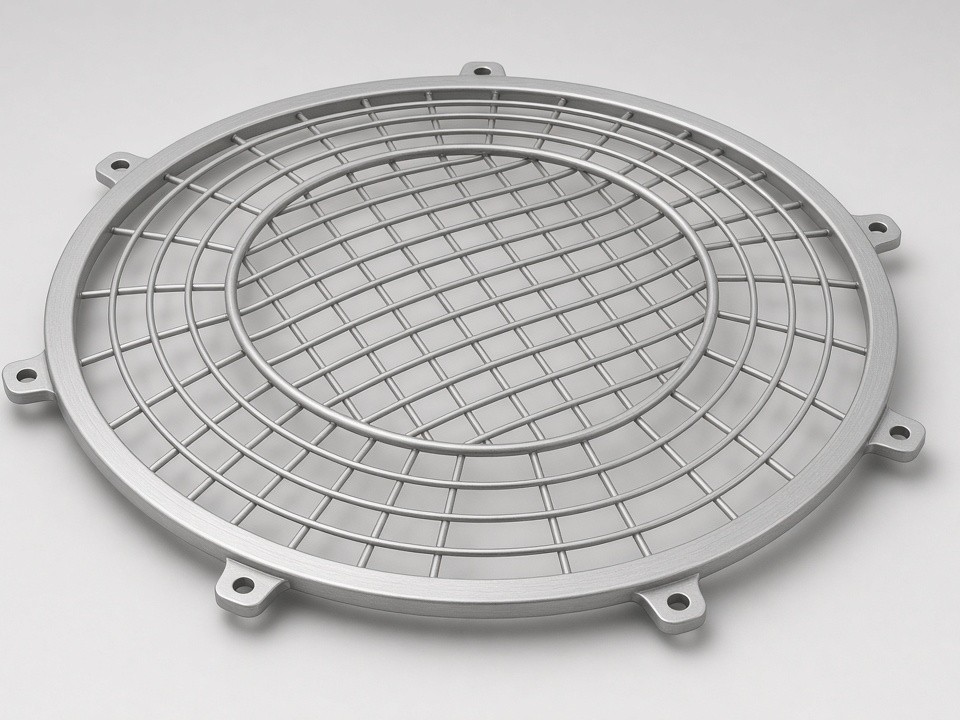
Fan guards protect rotating equipment in enclosures, HVAC units, machinery panels, and automation systems. Most designs combine perforated sheets, formed frames, mounting flanges, and welded reinforcements to meet airflow, safety, and structural requirements.
- Sheet Size
- 2000 × 4000 mm
- Press Brake
- Up to 230 t
- Laser Tolerance
- ±0.10 mm
- Prototype Lead
- 3–12 days
Material Selection for Fan Guard Applications
Material choice balances corrosion resistance, weight, and cost against the operating environment. Thickness range covers 0.8 mm perforated mesh through 4 mm structural frames.
SUS304 / SUS430
1.0–3.0 mm stainless steel for corrosion resistance in outdoor and washdown environments.
SPCC / Q235
Carbon steel for painted indoor use where cost efficiency drives the specification.
5052 Aluminum
Selected where weight reduction matters without sacrificing structural integrity.
Copper & Brass
Applied in specialized electrical or thermal applications requiring conductivity.
Perforated Mesh
From 0.8 mm upward, patterned for airflow while blocking finger and debris ingress.
Structural Frames
Up to 4 mm thickness for formed frames and welded reinforcement members.
Core Fabrication Processes
Fan guard production runs through a connected sequence of cutting, forming, punching, welding, and assembly operations held in-house.
-
Step 01
Fiber Laser Cutting
Five fiber lasers handle sheet sizes up to 2000 × 4000 mm, producing precise hole patterns and outer contours in a single setup.
-
Step 02
CNC Press Braking
Seven CNC press brakes form flanges, stiffeners, and mounting ears up to 230 tons.
-
Step 03
CNC Punching
Creates louvers, ventilation slots, and hardware-ready holes with repeatable positioning.
-
Step 04
Welding
TIG, MIG, and spot welding join frames and brackets for structural integrity.
-
Step 05
Tapping & Insertion
M2–M12 tapping and PEM insertion complete the assembly before finishing.
Tolerances and Inspection Points
Dimensional control is applied at first article and monitored through in-process checks. Every order includes dimensional reports, with material certificates provided when requested.
Laser cut edges hold this tolerance on hole patterns and outer contours.
Formed dimensions typically stay within this range across flanges and mounting ears.
Vision systems verify critical hole locations and flatness on first-article and in-process checks.
Prototype Through Repeat Production
The same tooling and process data carry forward from NPI into ongoing orders, eliminating requalification steps for OEM programs.
Prototype
3–12
working days
Small Batch
10–15
working days
Scheduled Run
15–25
working days
Surface Treatments and Secondary Operations
Finishing occurs after fabrication so weld seams and hardware remain accessible for inspection. All treatments are handled through qualified local partners.
Powder Coating
Durable color finish for carbon steel and aluminum guards.
Anodizing
Applied to aluminum components for surface hardness and corrosion resistance.
Passivation
Removes free iron from stainless surfaces to reinforce the passive layer.
Electropolishing
Smooths and brightens stainless surfaces for cleanroom and hygienic use.
Screen Printing
Adds part numbers, branding, or safety labels to finished guards.
Laser Marking
Permanent identification for traceability on metal surfaces.
Project Fit for OEM Buyers
Procurement, engineering, and quality teams use this route when drawings specify mixed processes—laser cut mesh, formed rails, welded corners, and inserted hardware—within one supplier.
Orders that start with a prototype and move into scheduled releases align directly with the production window and documentation package already in place.
- Mixed-process drawings consolidated under a single supplier.
- Prototype data carried forward into scheduled OEM releases.
- Documentation package aligned with ongoing production windows.
- Direct export shipments supported since 2019.
What to Send
Include STEP, SolidWorks, or DXF files with material, finish, and quantity details. Engineering review and DFM notes return within one business day.
Submit Drawings for ReviewSubmit Drawings for Review
Send STEP, SolidWorks, or DXF files with material, finish, and quantity details. Engineering review and DFM notes return within one business day.
Email your RFQ directly:
Email RFQ to [email protected]- Brand:
- Rapidsheetfab
- Address:
- Sanjiang Industrial Zone, Hengli Town, Dongguan City, Guangdong Province, China
Inquiry Module
Use the contact channel below to reach our engineering and sales team. Include your drawings, material specification, finish, and target quantity for the fastest turnaround.
Rapidsheetfab operates from Sanjiang Industrial Zone, Hengli Town, Dongguan City, Guangdong Province, China and has supported direct export shipments since 2019.