Custom Sheet Metal Fabrication
Custom End Effector Plates
We cut, bend, weld, and assemble end effector plates from customer drawings for robotics integrators and automation OEMs. Single-piece prototypes move directly into repeat production without changing suppliers.
- Laser tolerance
- ±0.10 mm
- Minimum order
- 1 piece
- Prototype lead time
- 3–12 days
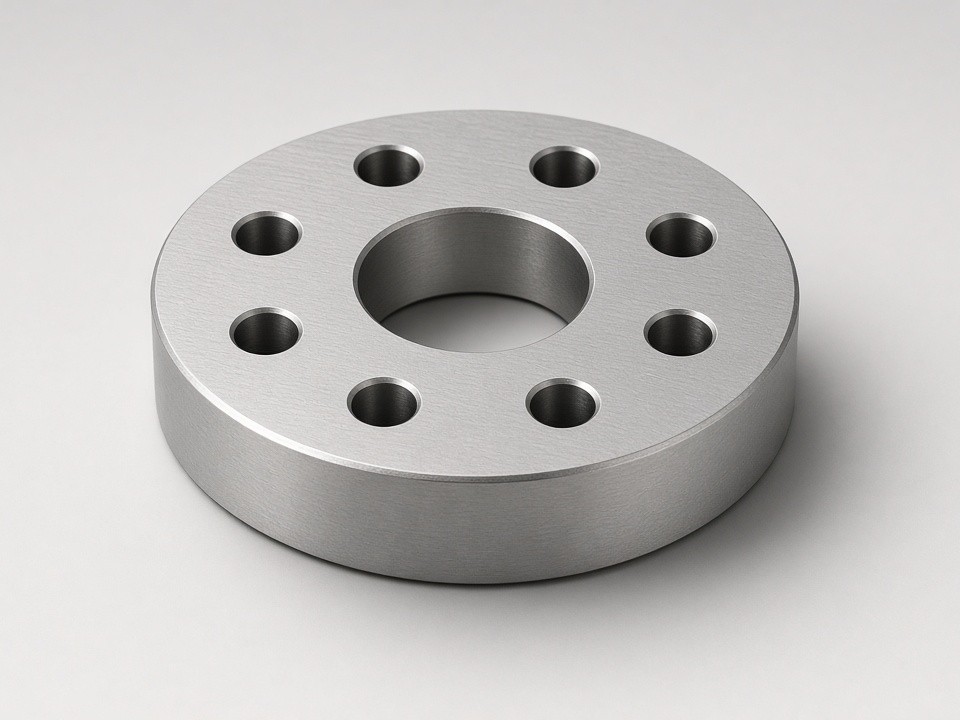
Plate Materials We Process Daily
End effector plates commonly use 3 mm to 8 mm stock. We run SUS304 and SUS316 for corrosion resistance in washdown environments, 5052 and 6061 aluminum for weight reduction, and Q235/Q355 carbon steel when cost or weld strength is the priority. Copper and brass appear on grounding or conductive versions.
Stainless Steel
SUS304 and SUS316 for corrosion resistance in washdown environments.
Aluminum
5052 and 6061 grades for weight reduction.
Carbon Steel
Q235/Q355 when cost or weld strength is the priority.
Copper & Brass
Used on grounding or conductive plate versions.
Cutting, Forming, and Assembly
Cutting, bending, welding, and hardware installation are handled in sequence under one roof, so features stay aligned from the flat pattern through to the finished assembly.
Cutting and Feature Accuracy
- Five fiber lasers handle sheets up to 2000 × 4000 mm.
- Standard laser tolerance sits at ±0.10 mm.
- Holes for vacuum ports, sensor mounts, and fastener patterns stay within ±0.10–0.20 mm.
- Slots, lightening patterns, and mounting flanges are cut in one operation.
Bending and Formed Features
- Seven CNC press brakes reach 230 t × 3000 mm.
- Flanges, return edges, and stiffening ribs are formed after cutting.
- Typical bend tolerance is ±0.20–0.30 mm.
- Parts up to 12 mm thick are formed when the design requires it.
Welding and Structural Assembly
- TIG, MIG/MAG, laser, and spot welding join brackets, gussets, and mounting bosses.
- PEM hardware insertion, riveted sub-assemblies, and tapped M2–M12 threads.
- All welds receive visual inspection.
- Critical joints can be documented with photos or dye-penetrant reports.
Hardware, Finishing, and Cosmetic Controls
After fabrication we install standoffs, captive fasteners, and locating pins. Surface options run through qualified partners: powder coating, anodizing, passivation, electropolishing, and laser marking. These steps remain outside our main facility and are quoted separately.
- Powder coating
- Anodizing
- Passivation
- Electropolishing
- Laser marking
Quality Flow and Documentation
Every order follows IQC–FAI–IPQC–FQC–OQC. CMM and 2.5D vision systems verify critical dimensions. First-article reports, material certificates, and RoHS/REACH documentation ship with each batch. ISO 9001:2015 certification covers the full process.
Inspection sequence
CMM and 2.5D vision systems verify critical dimensions. First-article reports, material certificates, and RoHS/REACH documentation ship with each batch.
Prototype to Low-Volume Continuity
MOQ is one piece. Once the design is locked, the same tooling and programs stay in place as volumes increase.
Prototype
3–12
working days
Small batch
10–15
working days after design lock
Regular production
15–25
working days
DFM Notes Specific to End Effector Plates
We review the drawing before quoting and flag the details that affect cost, distortion, and repeatability.
Send Drawings for DFM ReviewHole-to-edge distances
Reviewed before quoting to avoid edge breakout and deformation.
Bend relief
Checked so formed flanges and return edges can be produced cleanly.
Weld access
Confirmed for brackets, gussets, and mounting bosses.
Nesting efficiency
Flat patterns that nest efficiently reduce scrap on repeat orders.
Distortion risk
When a plate carries both vacuum and mechanical gripping features, we flag potential distortion risks during welding.
Request a Quote
Send PDF, DXF, or STEP files with material, finish, and annual quantity. We return a DFM summary and firm pricing within one business day.
Email drawings
Email Drawings for RFQSamples and correspondence
Sanjiang Industrial Zone, Hengli Town, Dongguan City, Guangdong Province, China