Custom Sheet Metal Toolboxes
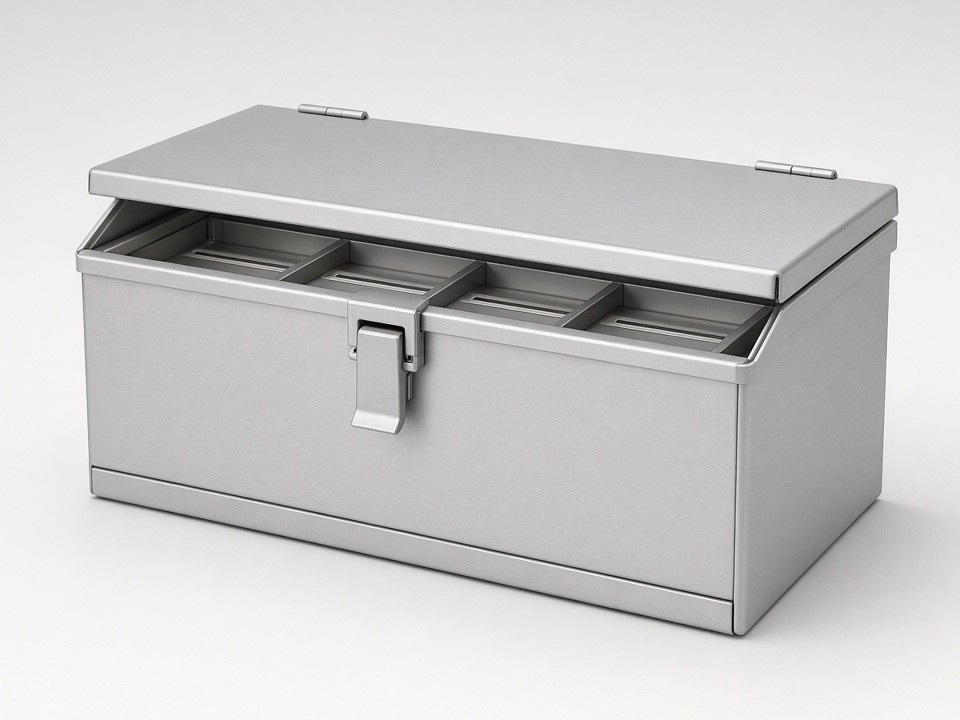
Industrial teams often need toolboxes that fit specific equipment layouts, carry heavy loads, and survive repeated transport. These boxes typically combine flat patterns, formed sides, welded seams, and installed hardware rather than standard catalog sizes.
- Laser tolerance
- ±0.10 mm
- Batch lead time
- 15–25 days
- Prototype lead time
- 3–12 days
Material and Thickness Options
Selection starts with the expected use environment. Stainless grades resist corrosion in wash-down areas. Carbon steel works for general shop floors when powder coated. Aluminum reduces weight for portable cases.
| Material | Common Grades | Thickness Range | Notes |
|---|---|---|---|
| Stainless steel | SUS304, SUS316 | 0.8–3 mm | Good for corrosion resistance |
| Carbon steel | SPCC, Q235, Q355 | 0.5–12 mm | Cost-effective for coated parts |
| Aluminum | 5052, 6061 | 0.8–6 mm | Lighter weight for mobile use |
| Copper / Brass | C1100, H62 | 0.5–3 mm | Conductive or decorative finishes |
Laser cutting
±0.10 mm
Held on profiles
Bending
±0.20–0.30 mm
On most features
Holes & PEM inserts
±0.10–0.20 mm
Positional accuracy
In-House Process Steps
Core cutting, forming and finishing operations stay under one roof, so toolboxes move from flat pattern to finished assembly without extra handoffs.
-
01
Cutting
Five fiber lasers cut sheets up to 2000 × 4000 mm.
-
02
Forming
Seven press brakes handle bends to 230 t and 3000 mm length.
-
03
Punching
CNC punching adds louvers, knockouts and stiffening forms without secondary operations.
-
04
Welding
TIG, MIG/MAG, laser and spot methods for seams and reinforcements.
-
05
Hardware insertion
M2–M12 taps and rivets installed to drawing requirements.
-
06
Deburring & brushing
Sharp edges removed before finishing.
When Additional Processes Add Value
Some toolboxes need more than cut-and-bend parts. The sections below cover when sealing, compartment rigidity and protective finishes are worth adding to the order.
Sealed enclosures
For toolboxes that must seal against dust or liquids, weld seams receive continuous beads and leak testing.
Multi-compartment builds
Multiple compartments or sliding drawers require spot welding plus riveting for rigidity.
Protective finishes
Powder coating or anodizing through qualified partners provides color and surface protection; these steps occur after internal fabrication and inspection.
Raw parts only
Customers who need only cutting and bending can stop at raw parts.
Full assemblies
Those requiring full assemblies combine cutting, forming, welding, hardware and finishing in one order to reduce supplier count.
Typical Project Flow
From first drawing to repeat batches, the workflow is designed to keep dimensions and finishes consistent across orders.
-
Inquiry
Most inquiries begin with a STEP or DXF file plus a short description of quantity, finish and critical dimensions.
-
Engineering review
DFM notes return within one or two days, flagging potential bend relief issues or tolerance conflicts.
-
First-article inspection
Reports accompany the initial shipment.
-
Repeat orders
Once dimensions are confirmed, repeat orders move to the same work cell to maintain consistency.
-
Lead times
3–12 days for single prototypes and 15–25 days for batches of 50–200 units.
Documentation Delivered With Each Order
These documents satisfy supplier-quality teams without extra follow-up.
- First-article inspection report with CMM and 2.5D data
- Material certificates on request
- Dimensional summary for critical features
- RoHS/REACH statements when specified
Request a Quote
Send drawings and requirements to [email protected]. Include material, quantity, finish, and any inspection or packaging notes.
Rapidsheetfab replies with a firm price and schedule based on current capacity.
Facility location: Sanjiang Industrial Zone, Hengli Town, Dongguan City, Guangdong Province, China
Email Your RFQ