
Engineering guide · Sheet metal manufacturing
Material Choice and Sheet Metal Lead Time: A Practical Guide to Faster Orders
Material selection can affect your delivery schedule before a part reaches a laser, press brake, or finishing line. We explain how stock availability, thickness, alloy, documentation, and finishing influence sheet metal lead time—and how OEM teams can make informed choices without compromising performance.
In brief: Confirm raw-material availability separately from fabrication time, specify acceptable alternatives early, and use common grades and thicknesses when the application permits.
Why Material Choice Sets Your Sheet Metal Lead Time
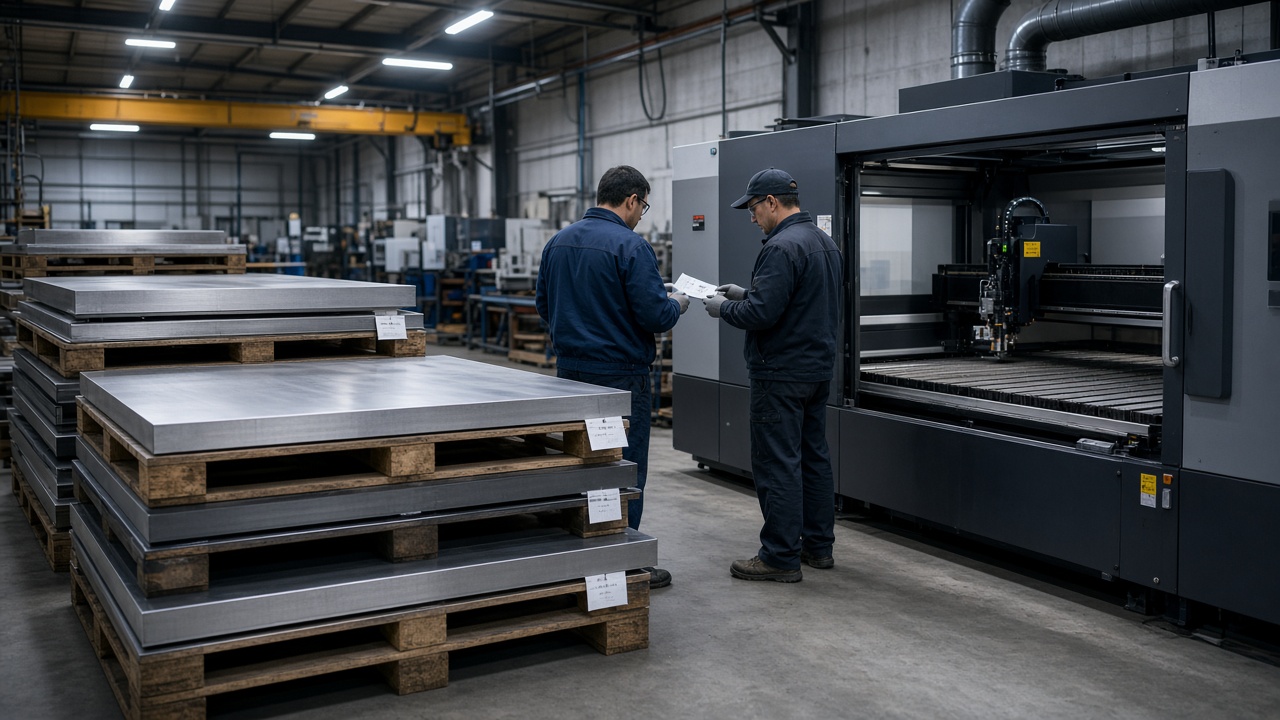
In many custom sheet metal orders, material selection is the first major schedule decision—and often the one with the greatest effect on the start date. A shop may have open laser and press brake capacity, but that capacity cannot release parts if the specified grade, temper, thickness, or surface condition is not available.
We see this most clearly when a design calls for a less common alloy or thickness, or when a required certificate or finish is raised after the quote. A readily stocked alternative may be sourced quickly; a material that needs a special purchase or mill run can shift the whole plan before fabrication begins.
Scheduling principle
Separate the time to obtain raw stock from the time to cut, form, finish, inspect, and ship the parts. That distinction makes schedule conversations more useful—and gives your team more options to act early.
This guide covers what each lead-time component means, common material availability tradeoffs, design and sourcing choices that can reduce waiting, and the information we recommend putting into an RFQ.
What Lead Time Means in Sheet Metal Manufacturing
In a manufacturing quote, lead time generally means the elapsed time from order confirmation or purchase-order acceptance to delivery. The exact start and end points matter: a quoted production window may begin only after drawings, material, and other requirements are approved.
What does material lead time mean?
Material lead time is the wait for the required raw stock to arrive at the fabrication shop after it is ordered. It is distinct from the time needed to make the part. If the material is already in suitable stock, this portion may be short; if it must be sourced from a mill or another distributor, it can be a significant part of the schedule.
What is a lead time in manufacturing?
Manufacturing lead time is the total elapsed time between placing an order and receiving the finished goods. For sheet metal, that can include material procurement, fabrication, outsourced finishing, assembly, inspection, packing, and transportation. Confirm which of these stages a supplier’s quoted figure includes.
Is it lead time or led time?
“Lead time” is the correct term. “Led” is the past tense of the verb “lead” and is not used to describe the time required to fulfill an order.
The four parts of total lead time
- 1 Material lead time: purchasing and receiving the specified sheet or plate stock.
- 2 Fabrication lead time: cutting, punching, forming, welding, hardware installation, and other production operations.
- 3 Finishing and assembly lead time: surface treatment, external processing where required, and assembly steps.
- 4 Delivery lead time: inspection release, packaging, and shipment to the receiving location.
How Material Choice Drives Lead Time
Material availability depends on more than the metal name. Grade, temper, thickness, sheet dimensions, finish, quantity, and documentation all affect whether a supplier can allocate stock or must find a less common source. Availability is regional and changes over time, so we recommend confirming it against the current RFQ rather than relying on a past order.
Stock vs. non-stock materials
Service centers commonly hold popular grades and formats and may be able to supply them in days, subject to location, quantity, and current inventory. A less common grade, temper, thickness, or surface specification may need to come from another region or be ordered to a mill schedule, which can extend sourcing to weeks. Ask your fabricator to distinguish confirmed stock from an estimated replenishment date.
Common grades and alloys
Common low-carbon or mild steel, galvanized steel, 304 stainless, and 5052 aluminum are often easier to source in standard sheet formats than specialized grades. Stainless 316, aluminum 6061, copper, and brass can be available through distributors, but the specific finish, thickness, temper, and required quantity can make a particular order less routine. Specialty alloys typically need an early availability check.
For example, a design that names “stainless steel” without a grade is not yet a complete sourcing requirement. Choosing 304 or 316, and stating the finish and thickness, lets a supplier check the relevant stock instead of quoting against an assumption.
Gauge and thickness availability
A common alloy in an uncommon thickness can still be a long-lead item. Sheet thicknesses and widths vary by market and supplier; nonstandard dimensions may require special ordering, slitting, or a larger purchase than the project needs. If the drawing allows a thickness range or a functionally equivalent standard gauge, state that flexibility in the RFQ and have engineering approve any change.
Coatings and pre-finished sheet
Pre-painted, pre-coated, brushed, or otherwise pre-finished sheet can reduce or change downstream work, but it narrows the material specification. Color, coating type, surface protection, and availability in the required dimensions can add sourcing time. Confirm that the selected stock suits the cutting and forming process and that exposed edges and bends meet the product’s appearance and corrosion requirements.
Mill runs and minimum order quantities
A mill may have production schedules and minimum order quantities that make a small custom requirement difficult to place quickly or economically. A distributor can sometimes split or hold stock, but that depends on the exact material and market. This is why one prototype in a mill-only alloy may have a very different material timeline from the same part made from a standard stock grade.
Material Comparison: Strength, Formability, Corrosion, and Schedule
The comparisons below are planning guidance, not a promise of local inventory. Actual lead time depends on grade, thickness, sheet size, finish, quantity, and the supplier’s current stock position.
| Material family | Typical stock availability | Formability | Corrosion resistance | Relative cost | Typical lead-time risk |
|---|---|---|---|---|---|
| Mild steel | Often readily stocked in common grades and gauges | Generally good for standard forming | Limited without a protective coating | Low | Usually low for standard stock; finishing may add time |
| Stainless steel | 304 is commonly sourced; grade and finish affect availability | Good, with grade-specific forming considerations | Strong; depends on grade and environment | Medium to high | Variable, especially for less common grades, finishes, or thicknesses |
| Aluminum | Common alloys such as 5052 are often stocked; others vary | Lightweight and formable; alloy and temper matter | Good in many applications; surface and environment matter | Medium | Often low for common alloys; some tempers or grades take longer |
| Copper and brass | Available, but selection may be narrower than common steels | Often formable, with material-specific process choices | Varies by alloy and service environment | High relative to common sheet steel | Moderate to high, depending on exact grade and format |
| Specialty alloys | Often limited or sourced to order | Varies substantially by alloy | Selected for demanding service conditions | High | Typically highest and least predictable |
“Specialty alloys” can include titanium, Inconel, and similar materials. Their supply routes, processing requirements, and documentation needs vary, so confirm availability before committing to a project date.
Balancing Performance Requirements Against Schedule
Start with the part’s actual job: loads, exposure, temperature, weight targets, electrical or thermal function, appearance, and service life. Then select the least restrictive material specification that meets those requirements. A grade chosen by habit can add sourcing time or cost without improving the part’s real-world performance.
For example, if a bracket was specified in a specialty corrosion-resistant alloy but the application needs only indoor corrosion resistance and ordinary structural performance, engineering may be able to qualify a readily available stainless grade or coated mild steel instead. The replacement must be checked for strength, forming, weldability, finish, and environmental compatibility; we do not recommend substituting material without design approval.
When a longer wait is justified
Use the specified higher-performance material when corrosion exposure, safety, fatigue, temperature, weight, or regulatory requirements make it necessary. In those cases, plan around the sourcing timeline rather than weakening a critical requirement to meet a date.
Design Choices That Shorten Material-Driven Lead Time
A design review can reveal places where common stock and standard processes will meet the same functional intent. These decisions are most effective before the drawing is released for purchasing.
Standardize thickness
Where strength, stiffness, and forming needs allow, consolidate parts around commonly stocked thicknesses. Reducing the number of unique gauges across an assembly can simplify purchasing and make it easier to combine jobs or use existing inventory. Ask the fabricator which thicknesses are typical for the specific grade and region.
Design for available sheet sizes
Part dimensions and nesting affect how well a job uses standard sheet formats. If a panel is just outside a common blank size, a small design change may avoid a special-size purchase or a second sourcing event. Review nesting and grain or finish direction with the fabricator before changing a cosmetic or dimensional requirement.
Bend radii and hole sizes
Use bend radii and hole sizes compatible with standard tooling and the selected material thickness. A material-specific bend allowance or an unusually small feature may require extra engineering review, a different setup, or additional process steps. Early DFM feedback helps identify those issues before the material is ordered.
Tolerance strategy
Apply tight tolerances to features that control fit, alignment, or function, and use practical general tolerances elsewhere. Tighter requirements can affect process selection, inspection, and approval time. Call out critical-to-function dimensions clearly so the manufacturing and quality teams can focus checks where they matter most.
Geometry complexity
Simpler part geometry can reduce programming, setup, forming, and inspection effort after the material arrives. It does not change a supplier’s mill schedule, but it can reduce the amount of the overall delivery window that remains once stock is on hand. For multi-part assemblies, consolidating compatible fabrication and finishing steps can also help avoid unnecessary handoffs.
Supply Chain Options That Affect Material Lead Time
The sourcing route is part of the schedule. The right route depends on how much material you need, how frequently you reorder, how specific the requirement is, and whether the material can be held for future releases.
Service centers vs. mills
A service center or distributor can supply material it already holds, sometimes in quantities suited to a fabrication order. Direct mill sourcing may be appropriate for large or recurring demand, a specific material specification, or a supply plan built around production schedules. For a small, urgent order, asking whether an equivalent specification is already available through a distributor may be more useful than waiting for a mill-only purchase.
In-house stock and consignment
When demand is repeatable, a fabricator may be able to hold common material or work with a customer on consigned or vendor-managed inventory arrangements. These options can reduce the wait between release and production, but they require agreement on material ownership, storage, replenishment, and forecast accuracy. Confirm that the held stock matches the approved grade, thickness, finish, and certification requirements.
Blanket purchase orders
A blanket PO can let a supplier plan material against expected demand and release quantities over an agreed period. For OEM programs, combining a forecast with scheduled releases can help avoid repeating a full sourcing cycle for every order. Define the forecast horizon, release quantities, revision control, and how changes to material requirements will be handled.
Urgent, standard, and blanket orders
An urgent order may rely on available stock, simplified scope, and a confirmed ship date; it cannot make non-stock material appear sooner. A standard order follows the normal purchasing and production plan. A blanket arrangement uses forecasted demand to plan ahead and may reduce repeated procurement waits. State which type you are requesting so the supplier can quote a realistic schedule and sourcing approach.
Vendor handoffs
Every additional supplier can add transport, queue time, communication, and inspection coordination. That does not mean every process should be in-house: specialist finishing may require a qualified partner. We recommend identifying those operations and their timing in the quote, then consolidating compatible fabrication, hardware, finishing coordination, and assembly where doing so improves control without compromising process suitability.
Finishing and Assembly Time Added by Material Choice
The chosen material can determine which finishes are suitable and how the part needs to be prepared. Aluminum may require anodizing when that surface treatment is specified; stainless steel may require passivation; and steel parts may call for plating or powder coating. Finish compatibility, surface appearance, masking, and the sequence of forming and coating should be checked before procurement.
Outsourced finishing can take longer than sourcing the sheet itself, particularly when a specialist process, color, or documentation package is involved. At Rapidsheetfab, we coordinate finishing options through qualified partners; these partner processes are not represented as wholly in-house operations. We recommend confirming the finishing route and its schedule as part of the original quote.
Before ordering
Check that the finish is compatible with the selected alloy and the part’s geometry, welds, hardware, and cosmetic requirements. A late finish change can affect both material selection and the production sequence.
Prototype vs. Production Material Strategy
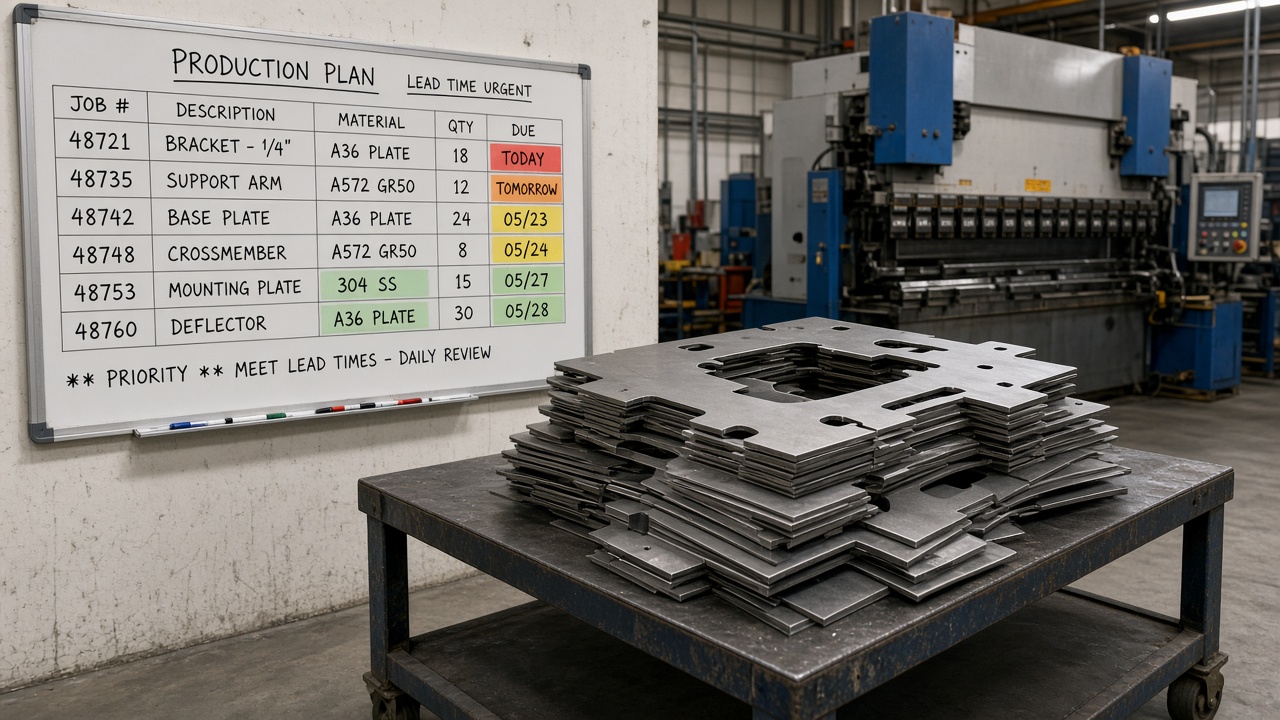
Prototype urgency and production consistency can point to different sourcing choices. Keep any difference visible in drawings, records, and validation plans so a temporary material decision does not silently become the production specification.
Prototypes
For an early fit or assembly prototype, readily available stock may help move learning forward, even if it is not the final production material. Document the prototype alloy, temper, thickness, and any surface-treatment differences, and clearly identify which requirements the prototype can and cannot validate. Rapidsheetfab supports one-piece prototypes, subject to drawing and process review.
Production
Lock the final production specification early enough to confirm sourcing, finishing, inspection, and documentation routes. For repeat demand, discuss forecasts, blanket orders, or safety stock so future releases are not dependent on a new material search each time.
Validation step
Before treating a prototype as representative, compare its material properties and finish with production requirements. Review load and stiffness, corrosion exposure, weldability, forming behavior, fit, and appearance as applicable. If the prototype used a substitute, have engineering document the limits of the test and repeat any validation that depends on a material-specific property.
Current Trends Affecting Material Lead Time
Material markets can change between design release and purchase order. Treat availability as a time-sensitive quote input, especially for repeat programs or products with strict sourcing and documentation requirements.
Supply volatility and tariffs
Regional shortages, trade policy, tariffs, and changes in shipping routes can influence which grades are available and where they can be sourced. The impact varies by material and market. For imported or project-critical stock, ask the supplier to confirm the source and validity period of the lead-time estimate rather than assuming last quarter’s availability still applies.
Sustainability and recycled content
Low-carbon or recycled-content requirements may narrow the eligible material pool or require additional supplier declarations and supporting records. If these requirements are part of your sourcing policy, state the required content threshold, evidence, and traceability expectations in the RFQ. That gives suppliers a chance to identify availability and documentation lead time up front.
Advanced and lightweight alloys
Demand for high-strength steels and lightweight aluminum alloys can affect stock depth in particular grades, tempers, and thicknesses. A material family may be widely used while one specific product form remains difficult to source. Specify the complete alloy and temper and check the exact sheet format, not just the broad material category.
Digital sourcing and instant quoting
Online quoting systems can speed up early comparison and may show stock-based alternatives or indicative availability. Treat automated estimates as a starting point until the supplier confirms material allocation, finish compatibility, and the full production plan. A drawing review remains valuable for custom parts that involve forming, welding, hardware, finishing, or assembly.
Material traceability and certifications
Mill certificates, material test reports, heat or lot traceability, and customer-specific records may need to be collected and checked alongside the stock. Request the required documents with the RFQ and clarify whether they must accompany each shipment. Asking after material has been purchased can create avoidable follow-up and release delays.
Material and Lead Time Mistakes to Avoid
These common RFQ gaps turn manageable sourcing questions into schedule surprises. We recommend resolving them before the purchase order whenever possible.
- 1 Specifying a rare alloy or thickness without checking stock. Confirm the exact grade, temper, and format before setting a delivery expectation.
- 2 Choosing a finish that needs an unplanned outside process. Identify finishing requirements and confirm the processing route and timing in the quote.
- 3 Changing material after the RFQ or order. A revised grade can require a new availability check, quote review, and approval before production continues.
- 4 Ordering a small quantity of a mill-only material. Ask whether a distributor or approved alternate can meet prototype needs while production sourcing is planned.
- 5 Ignoring certificates and traceability until release. State documentation requirements in the RFQ so they can be included in the sourcing and inspection plan.
RFQ Checklist: What to Specify for an Accurate Material Lead Time
A complete RFQ helps a fabricator check material availability and calculate the full schedule rather than estimating from an incomplete drawing. Along with your drawing files, include these details:
- 1 Material grade, alloy, temper, and thickness. Include the exact specification and any required sheet dimensions or surface condition.
- 2 Acceptable substitutes or alternate grades. Identify options that engineering can review; do not imply approval for an unvalidated substitution.
- 3 Required finish, coating, and surface condition. State color, appearance, masking, and any process-specific requirements.
- 4 Quantity, forecast, and delivery date. Include prototype, NPI, and expected repeat volumes, plus the date parts are needed at destination.
- 5 Certification and traceability needs. Name required certificates, inspection reports, lot traceability, and compliance documents.
- 6 Order type. State whether the request is urgent, standard, or planned under a blanket order, and identify any phased releases.
For custom assemblies, include the relevant PDF, DXF, STEP, or native CAD files, and flag critical dimensions, cosmetic surfaces, hardware, welding, and assembly needs. Clear inputs help us return a more useful DFM review and schedule discussion.
Practical Ways to Shorten Material-Driven Lead Time
The most reliable reductions usually come from making sourcing decisions earlier and reducing repeat purchasing friction—not from assuming every production step can be rushed.
- 1 Use standard stock materials. Start with common grades and gauges unless performance or compliance requirements call for something else.
- 2 Consolidate purchases. Group compatible parts by material and thickness where practical to reduce separate sourcing events.
- 3 Share forecasts. Provide rolling demand information so suppliers can assess material purchases and capacity in advance.
- 4 Consider blanket orders or safety stock. For repeat parts, agree how stock will be held, replenished, and released against demand.
- 5 Confirm material lead time early. Ask for material procurement time separately from fabrication, finishing, assembly, and delivery.
Frequently Asked Questions
What does material lead time mean?
It is the time needed to receive raw material after it is ordered. This is separate from the time to fabricate, finish, inspect, and ship the parts.
Is it lead time or led time?
“Lead time” is correct. “Led” is the past tense of “lead” and is not the term used for order fulfillment time.
What is a lead time in manufacturing?
It is the elapsed time from order placement or confirmation to delivery. For sheet metal parts, it can include sourcing, production, finishing, assembly, inspection, and shipping.
What is a typical lead time for sheet metal fabrication?
At Rapidsheetfab, typical prototype lead time is 3–12 working days, small batches typically require 10–15 days, and regular production typically requires 15–25 days. These are typical ranges, not guarantees: material choice, drawing readiness, process scope, finishing, documentation, and shipping can move the schedule. Confirm the current timing for your exact order and clarify whether the quote includes finishing and delivery.
Does lead time include finishing and assembly?
It depends on the quote. Ask whether the stated lead time includes material procurement, fabrication, outsourced finishing, assembly, inspection, and transport to your destination.
Which sheet material is fastest to get?
Common mild steel, galvanized steel, and common aluminum alloys are often among the quickest to source in standard gauges. Availability changes by market and date, so confirm the exact grade, thickness, finish, and quantity before committing to a schedule.
How long does sheet metal last before it decays, and does material choice matter?
There is no single service life: durability depends on the alloy, coating, environment, maintenance, and exposure. In outdoor conditions, galvanized steel and stainless steel generally resist corrosion better than uncoated mild steel, but the right choice should be based on the actual environment and required service life.
Which material is best for welding?
Low-carbon steel and common stainless grades are generally weldable with suitable process selection. Aluminum can also be welded, but it requires an appropriate process and filler selection. The best choice depends on the joint, thickness, appearance, load, corrosion exposure, and production requirements.
Conclusion and Next Steps
Material choice shapes the schedule at its earliest stage: stock availability affects when fabrication can start, while grade, thickness, finish, and documentation can all add procurement or release time. Choosing a standard material where it meets the application, reviewing design flexibility early, and planning repeat demand can help avoid preventable waits.
Use the RFQ checklist to give your supplier a complete specification, and ask for material lead time separately from fabrication and finishing. At Rapidsheetfab, we support industrial OEM projects from one-piece prototypes and NPI builds through low-volume and repeat production, with engineering review and quality documentation appropriate to the agreed requirements.
Discuss your RFQ with our teamNext step
Plan your material and delivery schedule
Share your drawings, material specification, quantities, finish, documentation needs, and target date. We can review the requirements and clarify material timing alongside fabrication and finishing for your project.